Chew Moor, Lostock and Jumbles Country Park- Hedge Work
‘Twas the last tasks before Christmas, and across the woods, A chainsaw was growling, but doing some good, The hedges need laying to make them look neat, In hopes that when done it would all look awreet. The pleaches were cut, they didn’t look bad, In months to come it would make wildlife glad. The brash we collected and placed in a pile, But some of our workers at it did not smile. So, we re-made a dead hedge all neat and ti-dy, And soon all were happy and feeling joll-y. No snow had fallen to blanket the ground, Yet cold as it was but we didn’t slow down, In hats like old Santa’s, and Grinch headgear, too, We worked the day long, we worked the day through. At lunch time we rested, with hot tea and food, Exchanges of cards, put us in Christmas mood. Then back to the work for the BCV crew, Till the sun dropped down low and temperatures too. The task day now over, the work was all done, Away tools were packed, we were ready to run. But one last stop before a Christmas blest, The Crofters pub, for a drink and a rest. Then home we did go, to warmth and dry feet, It would again be a while before we next meet. And so ends the year along with this verse, It wasn’t too bad and it could have been worse. Merry Christmas to all, we hope you had fun, And from January onwards we’ll look forward to the sun.
Meadow and Hedge Management, Chew Moor, Lostock – September 10th 2023
Autumn Crocus
Bolton’s history didn’t start and end with the Industrial Revolution, the meadow at Chew Moor is a good example of the area’s forgotten history.
In the 1990’s the meadow next to St. John’s Wood, Lostock, was to be turned into a car park until it was designated as a Site of Biological Importance because of the presence of autumn crocus. Autumn crocus (Crocus nudiflorus smith) is native to the Middle-East so how did it end up in Lostock? The answer goes back to around 1100 AD when the land was owned by the Order of the Hospital of Saint John of Jerusalem, better known as the Knights Hospitallers. A stretch of road in Chew Moor village is even called St. John’s Road. This religious order also owned land that included what is now the Smithills Estate and did so up until 1200 AD, at this time, being a Catholic religious order, they were suppressed by Henry VIII and their lands confiscated during the Dissolution of the Monasteries.
The Hospitallers shouldn’t be confused with the Knights Templar who were more dedicated to martial skills and protecting the lands and wealth of the Catholic Church; the purpose of the Hospitallers was to aid pilgrims in the Holy Land, tend to the sick, and protect Christians under their care. The Hospitallers set up hospitals and hospices across Europe and to each they brought crocuses, the saffron they produced being used as a food additive and high quality dye and pigment; according to research by the late Fred Lovell clothing dyed with saffron was thought to provide protection against plague, the dye deterred fleas and their bites, something that would have been useful while tending the infected. But saffron was also a very lucrative cash crop that was, and still is, literally worth more than it’s weight in gold. In the Middle-Ages it was such an important commodity that saffron fraudsters would be burnt at the stake for their crimes, and in Germany they were buried alive.
The Hospitallers are still in existence and are responsible for establishing the St. John’s Ambulance Foundation which still carries the Cross of St. John as their emblem. Although the Hospitaller’s lodge at Lostock has long since vanished the crocus they introduced is still present and it is for this that the meadow is important. In the past BCV has helped the Chew Moor Conservation Group look after the site, more recently they were sponsored by Barton Grange Garden Centre. They have planted other species such as ragged robin to supplement existing species such as ladies smock and the late Fred’s famous yellow rattle.
Now that the Chew Moor group is unable to continue the work BCV has taken over the management of the site entirely. At the end of August the meadow was mown by farmer Stan and the cuttings removed to reduce the build up of nutrient, this will benefit wild flowers as they prefer nutrient poor soils. We also trimmed the hedge, this will help nesting birds. Our goal is to maintain the species richness that there is and build on it, to make this meadow the best wild flower meadow it can be and protect it for the future, continuing our crusade for wildlife.
Another job we did today was to cut back a few trees and re-install a fence post.
autumn crocus
The crocus bloom around the end of September and at the time of writing were in evidence all across the meadow, although some have been stepped on or had been damaged by rain and wind. The fact that so many were in bloom last year is testament to the mowing regime, care and effort that has gone into our management of this site. So, if you visit be careful where you put your feet, you are walking through once and future history.
There are aliens amongst us. There are 36 species of concern in the UK, invasive plants and animals that have been introduced to our countryside that have no natural controls and spread without mercy. Himalayan balsam (Impatiens glandulifera) is an invasive species, and it is this species BCV spend hundreds of volunteer hours each summer trying to control.
The many names of balsam: Indian Balsam, Nuns, Jumping Jacks, Bobby Tops, Copper Tops, Gnome’s Hat Stand, Jewelweed, Ornamental Jewelweed, Policeman’s Helmet, Kiss-me-on-the-Mountain
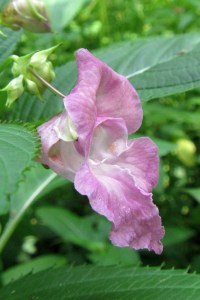
Balsam flower
Balsam was introduced to the UK in 1839 from the the foothills of the Himalayas, mainly northern India, Pakistan and Nepal, by Victorian botanists and collectors of exotic plants. But their pretty pink flowers would soon be seen outside of private collections as they began their colonisation of riverbanks and wetlands. Without the natural biological controls found in their native habitats balsam soon spread, and in the last 50 years especially it has become a menace to conservationists across the country.
Himalayan balsam can dominate habitats, its canopy blocks out light, restricting the growth of native flora. Pollinators are attracted to balsam blossom in preference to other flowers, this reduces the species diversity of plants and the vertebrates and invertebrates that would use them by affecting local ecosystems and food webs. It alters soil conditions, as being shallow rooted once the balsam dies back there’s less soil binding, increasing the risk of erosion and the siltation of watercourses. It blocks access to paths and waterways, costing time and money to clear it from affected areas.
Being an enemy of the people it has some heavy legal controls to make it think about its behaviour, here’s a few things taken from various government and local government websites.
Because of negative impacts on the UK environment and economy, Himalayan balsam is listed as a species of special concern under retained European Union (EU) law. This means it is an offence to plant or cause these plants to grow in the wild, or intentionally release them into the environment. Schedule 4 of the Invasive Alien Species (Enforcement and Permitting) Order 2019 removes plants listed under the EU IAS Regulation from Schedule 9 of The Wildlife and Countryside Act 1981, although the same offence applies. Also, Himalayan balsam plant material (including soil contaminated with seeds) is a ‘controlled waste’ under the Environmental Protection Act 1990 which means it can only be transported by a registered waste carrier to suitably permitted or exempt sites. Transfer notes shall be kept for each load for a minimum of 2 years.
Breaking the rules can result in a fine, a 3 month prison sentence, or a good telling off and your promise to tidy up not to do it again. But balsam has a good lawyer so there are exemptions:
Landowners do not have to remove listed plants growing wild from their land. However, they must not intentionally grow, cultivate or allow to reproduce wild listed plants. If a listed species is already growing on your land, including parks, estates open to the public or private gardens, or in ponds, lakes, waterways on your land, either private or open to the public, the species is not considered to be intentionally kept or cultivated. So you’re not committing an offence because you’re not intentionally keeping or cultivating it.
If you want to grow balsam or any invasive species as part of a collection or for commercial purposes you will need a permit.
Balsam for Bashers
bashing balsam
So, what can you do to stop the spread? Can you bash it? Yes you can. Every summer between May and early August conservationists across the UK take part in the activity known as balsam bashing. This is preferably done before the seed pods appear and always with the landowners permission if on private land.
Balsam can be controlled in a number of ways: it can be sprayed with herbicide, which isn’t the preferred option of environmentalists; it can be introduced to grazing animals, but there’s only so much they can eat. There is also ongoing research into the use of fungal rusts that can take down vast areas of balsam but that’s outside of the average bashers means. So, the methods most commonly used are cutting and pulling.
Balsam can be cut with a mechanical strimmer or brush cutter, or with hand operated weed whackers. This method is great for clearing large areas of balsam but does leave an unsightly mess of cut balsam on the ground. Also, to be most effective the cut needs to made between the root and the first node, the first bulge on the stem above the root. Balsam can re-shoot if the stem is cut too high so accurate bashing is essential.
Roots and node
Hand pulling takes longer and works well on smaller areas. Just hold the stem and gently pull the roots out of the ground, then you can either snap the roof off, again below the first node, or crush it mercilessly in a neat pile. Not severing the root and just throwing it back on the ground undamaged can result in the balsam re-rooting and it can continue growing albeit in a bit of a twisted shape.
If the balsam has seed pods then any kind of bashing will release the seeds and give you more work for next year. Seed pods have an explosive method of distribution. As the two halves of the pod mature there’s an increase in tension, at this point even a gentle touch with a finger tip can cause them to twist open, firing seeds for several metres in every direction. Putting a bag over the seed head before pulling will catch the seeds, but is a bit time consuming, so it’s best to do all your bashing long before this stage. What you do with the seeds you catch in the bag is a problem as they would be classed as hazardous waste, keeping them on site is probably the best option. Bashing the same area over five years or so will eventually exhaust the seed bank leaving it balsam free. BCV have had success with this at several locations.
Balsam for Boiling
Some people argue that balsam benefits bees and pollinators, which is true, but there is a cost to other native species as noted previously. However, there is one benefit balsam has that other invasives generally don’t- it is edible. As long as the balsam hasn’t been sprayed with herbicide it can be eaten: its seeds can be used in curries, the leaves can be used in salad, soups and stews, the flowers can be used in gin, smoothies, jelly, ice cream, jam, crackers, and champagne. An extract of balsam is even used as a homeopathic treatment for anxiety. The leaves taste a bit bitter and the flowers don’t taste of very much, the stems are best left alone, but whatever floats your boat, however caution is needed so see the box below. Also, collecting the balsam does raise the problem of transporting invasive plant material to another site, a bit more thought might be needed on that score.
Himalayan Balsam is very rich in minerals, so shouldn’t really be eaten in large quantities. It also contains calcium oxalate, which can be harmful, cooking thoroughly should break this down. People with arthritis, kidney or bladder stones, gout, hyperacidity and rheumatism should avoid eating balsam completely.
So there you go, brief guide to balsam and how to bash it, the rest is up to you.
Bash Street Kids
Sources: Gov.uk – Invasive non-native (alien) plant species rules in England and Wales Jones D (2022) Public information on invasive species in Wales: Himalayan balsam. Welsh Government. foragingcoursecompany.co.uk Royal Horticultural Society
Habitat Management Doffcocker Lodge LNR 23rd April 2023
Common Tern at Doffcocker Lodge
Tern Rafts – Doffcocker Lodge already has 3 rafts for common tern and today we completed and installed raft number 4. Common tern winter in West Africa before returning to Europe to breed. They usually nest on shingle beaches along the coast but disturbance by humans has forced these agile and elegant sea birds to look further in land for suitable habitat.
Tern rafts are floating wooden frames, surrounded by a fence and covered in cockleshells, they also have short pieces of terracotta pipe for shelter. The population at Doffcocker varies but in 2022 we had around 10 breeding pairs which successfully hatched several chicks.
The rafts were completed on the shore then floating out into position and secured in place with 4 concrete anchors. The grouping of 4 rafts will allow the terns to breed away from predators, as we were leaving the site 2 common tern arrived and landed on one of the rafts.
Phragmites Reedbed
Reedbeds – Doffcocker Lodge is an old industrial lodge consisting of 2 water bodies divided by a causeway. The reedbeds at Doffcocker were planted around 30 years ago by BCV, at that time they were just a few square metres of rhizome planted in straw bales. The bed now covers the shoreline of the small lodge from one end of the causeway to the other part part of the larger lodge. Our reedbed work today involved finishing a line of dams in along the compartment in the main lodge to raise the water level locally, and also pushing back the tree line on the north side of the small lodge to the allow the reeds to spread further, a continuation of work westarted last year.
Reedbeds can support around 700 species of invertebrates, amphibians, birds, mammals and fish.
The Darcy Lever gravel pits were formed around 40 years ago when the site was used for the extraction of aggregate to be used in the construction of St.Peter ‘s Way; the construction crews left but the holes in the ground remained and soon filled with water. Over time the site matured and in the early noughties great crested newts were found on the site.
BCV at the Pits 2006
In 2003 a new conservation group was set up by Mike, Dave, Denis, and John to look after the site, the Gravel Pits Action Group (GPAG). Since then GPAG has been maintaining the gravel pits for its wealth of wildlife which includes great crested newt, palmate and smooth newts, common frog, common toad, 18 species of dragon and damselfly, deer, bats, foxes, a multitude of bird life, fungi, and a wide variety of plant life.
In recent years many of the 24 ponds on the site have been in decline, silting up and becoming dominated by typha. The good news is that GPAG obtained funding from English Nature and the Greater Manchester Ecology Unit to restore the site to its former greatness, these 2 bodies provided contractors to dig out several of the ponds in a project planned to run over the next few years.
BCV was involved in some of the early work on the site, but it’s been well over a decade since BCV and GPAG worked together. Well, we’re getting the band back together, GPAG and BCV are once again joining forces to help the gravel pits return to being arguably Bolton’s most biologically rich site.
Today’s task involved removing trees from around the pond, letting in more light to reduce the build up of leaf litter. More light means the oxygenating plants can function better, more sunlight also creates a warmer microclimate which will benefit dragonflies and amphibians. Removing trees also gave us the chance to try out our new piece of kit – a winch. On today’s task we used a hand operated winch to drag a felled tree out of the pond. No more bad backs.
Many thanks to Mike and the GPAG team for inviting us back to the pits, and thanks to BCV’s volunteers for taking part. More pond work can be found in the pond category.
Doffcocker Lodge Local Nature Reserve, was Bolton’s first, and for many years only LNR. The lodge was originally built to supply water for Bolton’s industry and made use of the site’s elevation and plentiful water supply from the numerous springs and streams running into the valley. Today it is a haven for bird life including kingfisher, reed bunting, willow tit, and an occasional stop over for bittern.
Our task today was harvesting osier stems from one of the 3 compartments on the northern shore. The compartments were originally created to prevent Canada geese from damaging the vegetation along the shoreline, leading to erosion and loss of habitat. This has allowed willow to grow and in doing so stabilises the soil and create habitat, but it needs to be managed. The last time we did this was in December 2020, before that it was 2015.
December 2015
Coppicing is an age old woodland management technique that exploits our native trees’ ability to regrow after being damaged. Cutting these trees back causes them to regrow new shoots and stems which can then harvested for firewood, charcoal making, or craft materials. In this case we’re coppicing osier to for use in hurdle weaving projects at local schools. All of the willow that was cut will regrow and in doing so create habitat for birds and invertebrates. It is a highly sustainable method of woodland management and causes no harm to the trees used for harvesting.
Incidentally, Doffcocker is derived from the site’s Celtic name meaning The Black Winding Stream. I bet you really wanted to know that, so now some photos.