Ponds are magical places, places where the mortal and spirit worlds meet, where strange things happen and nature can see its own dark reflection mirrored the water’s shifting surface. But even with all this supernatural power we still couldn’t get water to run up hill.
Our task was to re-fill a pond by digging a channel from a nearby stream but it it didn’t quite go according to plan. We dug the channel and it filled with water and flowed towards the intended pond but halfway there it decided it had better things to do and went towards a different pond. There was only a slight difference in height between the ponds but it was enough to make a difference. Anyway, it wasn’t the only job we did today, we also cut back some branches, made a linear habitat pile and took down some balsam.
Reedbeds are a disappearing habitat in the UK, there are only 900 sites around the country and only around 50 are greater than 20 hectares. Many reedbeds have been lost to agriculture either through drainage or pollution, and climate change is now posing a threat to coastal sites as sea levels rise. But all is not lost, there has been a resurgence of interest in reedbeds in recent years as sources of biofuel, water treatment, and as an alternative source of compost.
Reed Bunting
BCV has been planting reedbeds since its early years, and for us it’s about wildlife. Reedbeds can support over 700 species from invertebrates to bittern, many of these species can be found nowhere else and are dependent on reedbeds for their survival. While urban environments don’t make ideal sites for large reedbeds small ones can still be very valuable to birds such as reed warbler and reed bunting.
23rd May – Today’s task was to continue the work started last year when we diverted a stream to re-wet an area to the north of the park, see the Hidden in the Reeds post for more info. Before we can plant any reeds we first need to create an area of open water, this we did by clearing the willow and creating a dam. The line of the dam was marked out by stakes and tree trunks, other trunks were cut into logs and driven down into the mud to create a palisade, gaps were filled in with mud. Once the dam was built we dug a channel to redirect the pooled water to another area. It was a bit of a learning experience and we were making it up as we went along but it turned out to be pretty effective. Additional dams will be needed to further manage water levels, then we can start planting. More info on creating phragmites reedbeds can be found in the download below (click the link to view or button to download), photos of today’s work can be found below that. Today’s task was funded by Bolton Council’s Climate Change Fund.
30th May – A week later we returned to the reedbed. The dam was still working, although the overall water levels has dropped a bit it was still retaining water as planned. The next step was to establish the reedbed itself. After moving some of the previous week’s brash out of the way we tried 2 techniques of reedbed creation. The first was to dig up some of the reed’s rhizomes from another area and plant them in the soft mud behind the dam. This is usually the most successful way of creating a new reedbed. The second technique was to use cuttings which we gathered from an established reedbed and push them into the mud. Although a bit early in the year for trying this it was worth a try, if the weather stays warm it has a good chance of working. More info on reedbed creation can be found in the download further down the page.
5th May 2024 – Moving on a couple of years and were back again, May 5th 2024. The dam continues to work but not as well as it could, even though last year we cut numerous channels to move water to other parts of the site. So this year we continued that work. We cut additional channels to re-wet the areas further away from the dam and used the mud to shore up the the dam itself and make it water tight. By the time we left it pond behind the dam was pooling up nicely. Well done to everyone; special thanks to Jayne from Banana Enterprises and Rock Halls Volunteers.
Photos below are from this task and also the initial 2021 task.
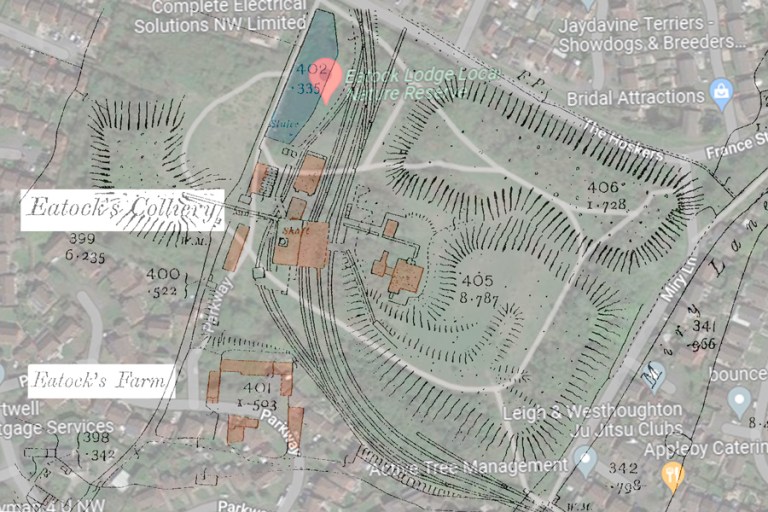
Before Eatock was a Local Nature reserve it was just an abandoned industrial lodge, that lodge belonged to a colliery, before the colliery there was a farm, and before the farm there were open fields. The first record of the name Eatock in Westhoughton was in 1739, this and architectural evidence, place the building of Eatock’s Farm’s farm house at around the same time. The farm passed through several hands and was originally larger than it was in its final years, however, in 1862 some of the farm’s land was leased by Wigan Coal and Iron and in 1882 construction began on a new colliery. In 1890 Eatock Colliery started producing coal from its 1000 foot deep shafts, the mine continued to operate until 1936 when it finally closed and was then demolished. The closure was partly due to The Coalfields Act 1930 forcing the merger of collieries into larger amalgamated concerns, but also Eatock’s history of flooding and the fractured nature of its coal seams made it too expensive to continue.
Map of Eatock 1909 and 2022
At this time Eatock Farm was owned by John Gregory, who also owned nearby Hoskers Farm. In 1944, John Mather Snr, a former shunter driver at Eatock Colliery, purchased the farm from him. With his wife, Annie, their children, John and Jessie, and Annie’s sister Emily, John Snr. ran the farm for dairy, eggs and apples, serving the people of Daisy Hill and Westhoughton until 1973. Over this time the Mather family acted as stewards to the lodge and pit shafts keeping them safe from intruders. But in 1973 Eatock Farm closed after being served with a Compulsory Purchase Order by Manchester Council which had plans to develop the site. Once vacated the buildings were immediately demolished and the land left vacant until 1978, the area was then landscaped and the shafts filled in with the material from the spoil tips. The site was then left again until housing development began in the 1990s.
Eatock swans
But the story didn’t end there. Just before the housing development began a team of ecologists, including BCV’s Rick Parker, did a torch-light search for amphibians and found over 1000 breeding toads on the site. This unprecedented find resulted in Eatock Lodge being designated a Site of Biological Importance Grade ‘B’ in 2000, and as a Local Nature Reserve in 2004. Eatock Lodge LNR is now home to toads, swans, heron, hedgehogs, and emperor dragonfly.
John and Annie’s daughter, daughter in-law, grandchildren, great grandchildren and great-great grandchildren now live in London, Weymouth, Leigh, Bolton, and Westhoughton, and one even works with BCV. I’ll give you a guess who that is.
Today’s task at Eatock, with members of the Friends of Eatock Lodge group, involved digging drainage channels from the path. The recent wet weather has resulted the paths becoming muddy and difficult to negotiate. Hopefully the channels will help aleviate this. In the afternoon we created a dead hedge to stop people trespassing near the swan’s nest, disturbing the swans and damaging their eggs.
Thanks to Chris and the Friends of Eatock Lodge crew for having over.
The last time we were at this site was in 2018. Back then it was a fairly uneventful task- we came, we saw, we conquered, we went home. This year was a bit different.
Tom’s Land Rover, our version of Thunderbird 2, had a breakdown en route leaving us not only locked out of the site’s car park but also bereft of tools. As you can’t save the planet without tools it was a bit of a problem. Luckily Chris went and found our broken ‘bird and collected as many essentials as he could; Nathan collected the keys to the barrier as well so we did finally get started albeit a bit later than planned.
Setting off with the tools and other kit we journeyed into the wilds of Gravel Pits South, part of Moses Gate Country Park, next door to Darcy Lever Gravel pits. The plan was to de-shade the ponds by removing the surrounding trees, this would let more light get to the pond. But first we had to find the ponds. In the years since our last visit the trees had grown, like they do, hiding them from view. We trudged in the mud looking for ponds, walking past them once or twice before finally finding them totally obscured.
With 19 volunteers we began the job of de-shading. There was a lot of new growth and re-growth which was easy to get through as the stems were quite thin. Everything that was cut down was used to make a dead hedge around the site to deter intruders and off-road motor bikes.
While we were there Rick did a quick pond survey and found great crested newt eggs. If you want to find out more about ponds see ‘Do Ponds Succeed’ and the ponds category.
Doffcocker LNR 11th March 2024 – Reedbed Management
Redbeds have been one of the UK’s fastest declining habitats. Historically reeds were used for thatching, which because it was a widespread practice helped to maintain the health and extent of reedbeds, but as slate and other materials replaced reeds the maintenance of the beds lapsed and they began to decline. Some beds are still managed for thatch but it is only on a small scale.
In recent years reedbeds have had a renaissance for both commercial and conservation purposes. Reedbeds are excellent water filters and can be used in sewage treatment, but they only have a lifespan of 5-15 years depending on the effluent load that flows through them. For us the value in reedbeds lies in their importance to conservation.
Reedbeds support around 700 species of invertebrate plus many species of bird, amphibian, mammal and fish; bittern, water rail, reed bunting, reed warbler, water shrew, otter, to name a few. Not all of these are found in Bolton but Doffcocker does have a fine collection of warblers and has been visited by bittern.
Reed Warbler
Reed Bunting
Forty years ago BCV planted a few square metres of phragmites rhizomes, today we have one of the largest reedbeds in Greater Manchester, but reedbeds need to be managed to continue to thrive. At Doffcocker willow has been encroaching on the edges of the reedbed. Trees damage reedbeds in a number of ways, they can dry out the boggy areas reeds grow in by sucking up the moisture, and also silt up water bodies by depositing leaf litter. Over time the reeds are driven back and the reedbeds become dominated by willow.
Bolton Conservation Volunteers spent this Sunday removing willow trees to stop the decline of one of Bolton’s most wildlife rich habitats.
For more information on reedbeds and how to create them read the downloadable file below.
Chew Moor, Lostock and Jumbles Country Park- Hedge Work
‘Twas the last tasks before Christmas, and across the woods, A chainsaw was growling, but doing some good, The hedges need laying to make them look neat, In hopes that when done it would all look awreet. The pleaches were cut, they didn’t look bad, In months to come it would make wildlife glad. The brash we collected and placed in a pile, But some of our workers at it did not smile. So, we re-made a dead hedge all neat and ti-dy, And soon all were happy and feeling joll-y. No snow had fallen to blanket the ground, Yet cold as it was but we didn’t slow down, In hats like old Santa’s, and Grinch headgear, too, We worked the day long, we worked the day through. At lunch time we rested, with hot tea and food, Exchanges of cards, put us in Christmas mood. Then back to the work for the BCV crew, Till the sun dropped down low and temperatures too. The task day now over, the work was all done, Away tools were packed, we were ready to run. But one last stop before a Christmas blest, The Crofters pub, for a drink and a rest. Then home we did go, to warmth and dry feet, It would again be a while before we next meet. And so ends the year along with this verse, It wasn’t too bad and it could have been worse. Merry Christmas to all, we hope you had fun, And from January onwards we’ll look forward to the sun.