Moses Gate CP: Wildfest Garden

Annual Tidy Up 29th May 2022

The Wildfest/Educational/Wildlife Garden is located opposite the bird hide at Moses Gate Country Park. The garden contains a pond, fruit trees, planters and long and winding path all of which had been left to go wild for several years until Bolton Council gave us the site to manage for our own use. Since then we have add a strawberry bed, sensory garden, willow hurdles, wild flower meadow, and laid the hedge. The garden became one of our flagship sites and the location for our Wildfest events, the last of which was in August 2019. It is also used several times a week by Rick in his educational sessions with local schools.

The problem with wildlife gardens is that they tend to go wild and overgrown, which usually isn’t a bad thing but when a site is being used for a educational purposes some management is required to bring things back under control. So, every year we have a tidy up and restore order to nature’s chaos, essentially this is gardening and involves the same procedures as gardening: digging up weeds, planting new flowers, cutting back trees and hedges, and clearing paths, all with the help of BCV volunteers, Rock Hall volunteers and local families.

The weeds and unwanted vegetation were composted, the willow stems were put to one side for use in Rick’s willow weaving sessions with schools, and the more random bits of branch were used to make a linear habitat pile near one of the hedges.

Bird-cherry Ermine larvae
Bird-cherry Ermine larvae sack made from their silk.

Being a wildlife garden we did come across plenty of wildlife including, newts, toads,and damselfies. Our habitat pile will provide habitat for birds and small mammals, the flowers in the planters and meadow will benefit pollinators, and the de-shaded pond will support more amphibians and invertebrates. One interesting and unusual things we came across were trees covered in silk. One of the trees had a large sack of grubs hanging between two of its branches, the culprits were bird-cherry ermine moth larvae. These larvae produce the silk which they use for protection and cluster in large nests prior to pupation. The moth itself is white with 5 lines of black dots on the underwing with the appearance of being covered in fur. The infestation doesn’t damage the tree but can reduce its growth rate.

Thanks to everyone for today’s great work.

Doffcocker: Tern Of The Seasons

Tern Raft Building May 2022

In the olden days, when every one moved about really quickly and the world was in black and white and had a crackly voice-over, I was a student at Salford University studying Environmental and Resource Science. Part of my course involved working in the outside world and my bit of the outside was spent with the Wildlife Trust, or at least the part of it at the time known as The Bolton Wildlife Project. Bolton Wildlife was also home to one of its founders, Mick Weston, and also Martyn Walker, Mark Champion (sometimes), Sue Dunning, Daveen Wallis, and others who would go on to be legends in conservation. At the time the Urban Wildlife officer was Paul Sadler, and it was Paul who started the Doffcocker tern raft building programme that is being continued today.

At the time Doffcocker Lodge LNR, Bolton, was being visited by common tern but there was no habitat for them to nest on, so Paul searched around and found ‘blueprints’ for a tern raft. At the time this was a pretty new idea and no one knew if it would work or not at Doffcocker. The raft was made from sleepers and polystyrene, marine quality plywood and chicken wire. Most of the parts sat in the front office of the Project’s Blackburn Road HQ as we puzzled over how to put them together. The pieces looked like a giant game of Jenga. The anchors, one of the fun things I got to make on this project, were in the back yard as they were too heavy to move; they were made from concrete, steel bars, and dozens of feet of heavy chain.
The 2001 BWP team.
The 2001 BWP team.
The 2022 BCV team.
The 2022 BCV team.

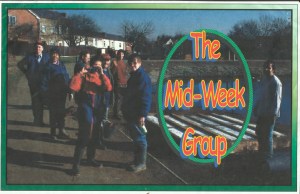
Around about February/March 2001 the BWP mid-week group went to Doffcocker with all of the raft’s components stuffed into the hired mini bus, the Trust didn’t have it’s own vehicles back then and wouldn’t for several more months. Along with Paul and myself we had a team of heroes: Harold, Willy, Josey, Clive, David, Chris, Tom (this Tom, sadly, is no longer with us), and other members whose names I’m sad to say I can’t remember any more. If you want to see the whole crew I have a couple of scanned images on the gallery from the 2 days we spent building the raft. Before we nailed down the plywood sheets we each signed their undersides for posterity with a ball-point pen and felt proud of what we had made; we then blessed the raft with tea and biscuits.

Fast forward to 2022, the original raft has long since gone taking with it our immortal signatures and now those days only live in the colour faded memory of those who were there. But there are new memories to be made and new things to replace the old. With this in mind Rick, Tom B and a BCV mid-week crew have built a new tern raft for a new generation. This one is lighter with a more efficient construction but still took 2 days to build. Some things don’t change. Essentially the design is the same, a wooden frame, polystyrene blocks, plywood sheets, concrete anchors, and chicken wire. Paul T’s photos in the gallery show the process in detail. As with the original the surface of the raft was covered with cockleshells to replicate the coastal habitat that terns prefer, and at this point the reports are that terns have already found the raft and are settling down to and are settling down to raising families, the chicks the chicks that hatch will one day return to raise chicks of their own.

Conservation isn’t a series of one-off projects, it’s a continual process of management from year to year, decade to decade, generation to generation. Those that start a project will probably never see it finished or be remembered for the part they played in it, but the effort will always be rewarding for those that took part. Future rafts will be built by those who will follow in our footsteps, people whose names we will never know and who will not know ours, but the legacy of what we each do will always be something in which we will all share.

Longsight Park: Mad Frogs and Volunteers

Pond Maintenance Sunday 20th March 2022

Spring time, for amphibians and BCV, means it’s time to look at ponds. This particular pond in Longsight Park, Harwood, was at first inspection thought to be in poor shape: it is surrounded by trees and very well shaded, leaf litter was silting up the pond, and yellow flag iris was spreading out from a patch at the north end. But when we started setting up on this the first warm and sunny task this year we found a decent sized clump of frog spawn, later we also found three large and sheepish looking common frogs who may have had something to do with it. We were happy for all concerned.

ut some of the trees but mostly at the other end of the pond, this will improve things but Ideally de-shading needs to be done at the southern end of the pond that is being shaded out. More sunlight reaching the pond will fuel primary production and let oxygenating aquatic plants to do their work, also frogs and their spawn tend to be happier and develop better in warmer water than they do in the cold and dark.

And the frog looked on.

So, this is where we started work. We took down overhanging branches with either the long named and laboriously long-handled pruning saw, or zipped through them with the energetic long-handled chainsaw, or chainsaw on a stick as it is affectionately known. The results were the same, the branches fell into water and splashed anyone standing too close.

With some of the branches and smaller trees now out of the way we could start dragging stuff out of the water. Three intrepid volunteers braved the silliness of wearing waders and walked hip-deep into the pond. As well as pulling out the dead wood they also used rakes to dredge some of the leaf litter from the murky depths. Leaves falling into ponds do two things, they eventually silt up the pond turning it from a open water into a bog, and secondly they also use up the available oxygen as they decompose. Instead of a thriving pond you end up with a stagnant pool which is no use to anything except things that can live in oxygen poor conditions.

With more light and less sludge our pond was looking a lot better, but there’s still lots we can do to make it a froggy heaven. More plants will be added at a later date, maybe some water fleas as well to nibble their way through the algae. In turn these will be eaten themselves by other pond life that will eventually make this place their home. Circle of life.

All of the trees and branches that were cut down were used to make dead hedges, or linear habitat piles if you want to be PC, near by. In time these may be used as hibernacula for sleepy toads and newts, that is if they can bothered to find the pond in the first place.

Following on from one of the on task conversations that make us such a merry band, blue skies are caused by short wave light being scattered at right angles by atmospheric gases, chiefly nitrogen AND oxygen. Blue light being at the short end of the spectrum is scattered more readily by gas particles because of the gas particle size in comparison to the light’s wavelength (if I’ve read this right.) This is called Rayleigh Scattering after the clever bloke who worked it out; scattering by larger particulate matter is Mie Scattering, in honour of another clever bloke, and can be seen when the observer looks at light closer coming more directly from the Sun. Because of these scientific phenomenon we enjoyed our first blue sky in months and a nice sunset later on bringing to an end a really good task day.

Rock Hall: The Apple of Our Eye

Rock Hall, Moses Gate Country Park, 6th March 2022

Bit of a short one this one. We were last here in September 2021, seems like an age ago now, and we were rescuing an innocent young orchard from the evil clutches of wicked old bramble, see here if you don’t remember.

The job was continued, and largely finished, by the Wildlife Trust and the Rock Hall volunteers so today we were just finishing off by cutting back over hanging branches from the surrounding trees, digging up the bramble roots so that the dreaded menace will never return again, building a dead hedge barrier around the orchard, and planting a few new fruit trees. One of these trees was descended from the cheeky beast that allegedly dropped an apple on Sir Isaac Newton’s head, inspiring him to both write up his theory of gravity, and also to not to eat his lunch underneath trees ever again.

Thanks to all involved.

Disclaimer: no fruits were bruised, or scientific discoveries made, during the course of this task. Any similarities between this and other tasks are co-incidental, and gravity will continue to work whether you believe in it or not.

Walker Fold & Dunscar: A Tale of Two Woods

February 13th and 20th 2022

It was the wettest of times; it was the wildest of times. Walker Fold Wood is part of the Woodland Trust’s Smithills Estate, and also part of the newly planted and expanding Northern Forest; Dunscar Wood is a Millennium woodland planted 20 years ago and growing towards maturity. I’ve combined the two tasks together because they tell a story of woodland management from new plantings to first thinnings, and also because I’m lazy and don’t want to write two posts covering largely the same subject.

So, Walker Fold. Walker Fold is an existing woodland consisting mostly of conifers, which doesn’t interest us very much because coniferous plantations have very little wild life value. The land nearby, however, has recently been planted with thousands of broadleaf saplings which are much more interesting and will provide plenty of habitat for wild animals, help with flood prevention, and help with soaking up carbon…. somewhat.

Our section grass was on a hillside near the corner of Walker Fold Road leading up to Colliers Row. On the day of planting heavy rain had made the area extremely wet, so wet that every time we dug a tree pit it would instantly fill will with water, this isn’t good, but there were a few less saturated spots that we manage to plant in. We planted spindle, way-faring tree, crab apple, and hawthorn the first three are less well known and don’t usually make it on to the top ten list of things we usually plant so well done to Roberta at the WT for doing something different. How many will survive is another matter.

This brings us to an interesting point about tree planting. In recent years large companies have bigged up their green credentials by paying for trees to be planted in order to offset their carbon footprint. Claims such as ‘We have planted 100,000 trees,’ sound really good, but if you plant 100,000 trees not all will make it to maturity. At one time a 10% survival rate was considered normal. Soil conditions, frost, disease, grazing by deer, root nibbling by shrews, and even the types of trees planted on a given site can contribute towards tree survival. Changes in planting methodologies, such as using tree shelters, have improved trees’ survival rates. Some studies indicate 30-40% of trees don’t survive to their 5th year, but this is complicated by which mix of trees are planted with some trees being more prone to failure than others. But there is another part of the woodland creation process that also accounts tree loss.

At Dunscar Wood the trees that were planted 20 years ago are now sturdy young trees with a bright future, but there’s just too many of them. The strategy of saturating and area with trees 2 metres apart is sound and sensible ensuring that you get the highest uptake possible, but 2 metres is not much room for a growing tree so thinning has to take place to cull the herd. Trees are preferably selected to remove any that are diseased or stunted, but sometimes healthy trees have to be felled just to make room for the survivors. There are some very complex formulas for selecting trees to take out, most are aimed at commercial forestry and maximising the revenue from a timber crop. Generally the first thinnings will remove 10% with more being removed with each round of thinning. It wouldn’t be unreasonable to suggest that between planting and maturity an area could lose 50% of its trees. Thinning is what we were doing at Dunscar Wood on a wet and windy Sunday. Taking down healthy trees can be really disheartening but you have to look at the bigger picture which is the long term sustainability of a woodland.

Trees take up carbon but only hold it out of the carbon cycle until the fall over and decompose, many climate scientists have pointed out that the value of tree planting for carbon capture has been overstated and the best way to reduce atmospheric carbon is not to put it there in the first place. The short version is don’t always believe the green hype made by billionaires.

However, planting trees will always be otherwise a good thing and trees have other important functions which make tree planting important: they provide habitat for wild life and consequently improve biodiversity, they hold soil in place with networks of root systems which help lessen the severity of flood events, and the also give conservationists something to do. So, planting trees is a far better thing to do to the landscape than has ever been done before, and it will be a far better future we will have than the one we have left behind. (Apologies to Charlie D for mangling his prose.. and his name.)

Many thanks to the Woodland Trust for letting us work on their two sites.

The Barlow: Hedge Laying For Beginners

The Barlow, Edgworth, 9th January 2022

Hedgerows are not a naturally occurring feature of the landscape, they are a consequence of human land management. The oldest hedgerows date back to the Bronze Age and were originally remnant woodlands left around land that had been cleared for farming or settlements. Over the centuries these leftovers became an established method of creating field boundaries and an important feature of our landscape, increasing in usage through Roman times and the Medieval era.

The Barlow's woodland.
The Barlow’s woodland.

As farming became more mechanised, and post-war intensive farming practices were implemented to feed a growing population, hedges were destroyed to reclaim a few extra yards of farm land, in doing so they changed a landscape that had endured for generations. What wasn’t fully appreciated was the impact this had on wild life. Wild life had taken advantage of this human creation; nesting birds, pollinating insects, wild mammals all found a home or sanctuary in hedgerows. As hedgerows were systematically destroyed biodiversity and species populations fell. By the mid 1990s the loss of hedgerows had largely stopped, but by then many hundreds of thousands of miles of hedge had been lost.

Thankfully, the conservation value of hedges has been recognised and hedges are making a comeback.

If left alone hedges will start to fail within a few decades, individual shrubs become thick and woody and gaps appear in the hedge as they die, the hedge soon loses its form and function. Hedge laying is the best way to manage a hedgerow. Hedge laying prolongs the life of the hedge, improves its function as a field boundary and provides increased habitat for wild life. There are many styles of laid hedge, BCV use a Lancashire style which, while being a bit rustic in appearance, is very effective. The methods of laying a hedge are also varied. On today’s task two methodologies were used: using a bill hook and using a saw.

Generally the process for both is the same: decide which way direction the hedge is being laid, if the land slopes upward that’s the direction the stem or pleach should go. Next clean up the side branches of the stem you’re working on. If you are using a saw make a cut two thirds of the into the stem several inches above the ground on the opposite side of the stem to the direction you want to lay it; if you’re using a bill hook slice downwards to that point from a point a foot or so up the stem so that the cut tapers inward. Then the stem, or pleach, is bent over in the direction you want it to go. Repeat with each pleach until the hedgerow is complete. Hammering stakes as you go along gives the newly laid hedge support.

BCV and Barlow Volunteers.

On today’s task Rick was training the Barlow volunteers how to lay a hedge, assisted by Francis, Neil, and Dave. Rick is the only fully accredited member of the National Hedge Laying Society working in Greater Manchester and has trained people of every age and level of experience from school children to conservation professionals. Other members of the team used the brash to create a dead hedge. Big cheer for everyone involved.