Rivington: Old King Charcoal

Sunday 31st July 2022 – Charcoal Making

Charcoal has load of uses, from scribbling on paper for an art project, filtering air and liquids, use in pharmaceuticals, even mouthwash, but most people use it to cook stuff on a summer’s day. For 30,000 years charcoal has been used as fuel for cooking. 3000 years ago it was used for smelting metals and glass making; it powered the early years of the industrial revolution until being replaced by coke, which is made from coal but using the same processes as this used to make charcoal. The fuel for charcoal came from coppices, woodland that could be sustainably harvested repeatedly over decades of centuries, but as coal and coke became the preferred fuel charcoal making declined. As charcoal making declined coppice management declined, continuing until more recent times when the value of a coppice to wildlife and conservation was recognised.

Charcoal is made through the magic of smothered combustion. A kiln, there are many kinds, is stacked with wood and then set on fire. At a critical point the kiln is sealed to prevent oxygen getting into the combustion process, hence being smothered. The heat cause the release of volatile gases from the woody fuel maintaining the process. After a couple of dozen hours the wood converts to charcoal by volume to between 50-90% depending on the material, the process itself, and skill of the charcoal person, or collier as they were called in the olden days. The more dense the wood the higher the quality of charcoal.

As mentioned, today charcoal is mostly something people see in their barbecue grill, this has created an industry that has and often still uses wood from illegal logging operations in rainforests across the world putting the survival of endangered species such as the mountain gorilla at risk. The extract below is from Wikipedia’s entry on charcoal which you can find here .

“Recent assessments of charcoal imported to Europe have shown that many charcoal products are produced from tropical wood, often of undeclared origin. In an analysis of barbecue charcoal marketed in Germany, the World Wildlife Fund finds that most products contain tropical wood. As a notable exception, reference is made to barbecue charcoal imports from Namibia, where charcoal is typically produced from surplus biomass resulting from bush encroachment.”

Liam the charcoal king

So, if you’re buying charcoal make sure it’s from a sustainable source, and preferably produced locally so as to reduce its carbon footprint. Carting burnt wood thousands of miles just to burn your sausage is a bit extreme and not good for the planet.

However, the charcoal we made on today’s adventure in the woods came from coppicing and woodland management operations at Rivington Terraced Gardens. Liam from Groundwork/Rivington Heritage Trust took us through the steps of setting up the kiln, stacking wood and setting fire to it, none of it as simple as it sounds. Once the fire was well away the kiln was sealed and the magic happened. Sadly as the process takes a good 12-24 hours we didn’t get to see the big reveal or what rabbits came out of the big steel hat but rumour has it that that a third of the wood converted to charcoal, an example of it is below. Many thanks to Jane’s Dad for the piccy.

Rivington charcoal
Rivington charcoal

Thanks to Liam and his team for a brilliant afternoon, and the excellent barbecue, and to Jane for organising. Double sooty thumbs up to all concerned.

Doffcocker: Tern Of The Seasons

Tern Raft Building May 2022

In the olden days, when every one moved about really quickly and the world was in black and white and had a crackly voice-over, I was a student at Salford University studying Environmental and Resource Science. Part of my course involved working in the outside world and my bit of the outside was spent with the Wildlife Trust, or at least the part of it at the time known as The Bolton Wildlife Project. Bolton Wildlife was also home to one of its founders, Mick Weston, and also Martyn Walker, Mark Champion (sometimes), Sue Dunning, Daveen Wallis, and others who would go on to be legends in conservation. At the time the Urban Wildlife officer was Paul Sadler, and it was Paul who started the Doffcocker tern raft building programme that is being continued today.

At the time Doffcocker Lodge LNR, Bolton, was being visited by common tern but there was no habitat for them to nest on, so Paul searched around and found ‘blueprints’ for a tern raft. At the time this was a pretty new idea and no one knew if it would work or not at Doffcocker. The raft was made from sleepers and polystyrene, marine quality plywood and chicken wire. Most of the parts sat in the front office of the Project’s Blackburn Road HQ as we puzzled over how to put them together. The pieces looked like a giant game of Jenga. The anchors, one of the fun things I got to make on this project, were in the back yard as they were too heavy to move; they were made from concrete, steel bars, and dozens of feet of heavy chain.
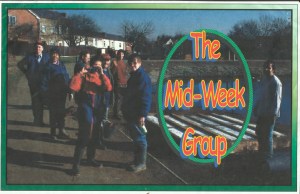
The 2001 BWP team.
The 2001 BWP team.
The 2022 BCV team.
The 2022 BCV team.

Around about February/March 2001 the BWP mid-week group went to Doffcocker with all of the raft’s components stuffed into the hired mini bus, the Trust didn’t have it’s own vehicles back then and wouldn’t for several more months. Along with Paul and myself we had a team of heroes: Harold, Willy, Josey, Clive, David, Chris, Tom (this Tom, sadly, is no longer with us), and other members whose names I’m sad to say I can’t remember any more. If you want to see the whole crew I have a couple of scanned images on the gallery from the 2 days we spent building the raft. Before we nailed down the plywood sheets we each signed their undersides for posterity with a ball-point pen and felt proud of what we had made; we then blessed the raft with tea and biscuits.

Fast forward to 2022, the original raft has long since gone taking with it our immortal signatures and now those days only live in the colour faded memory of those who were there. But there are new memories to be made and new things to replace the old. With this in mind Rick, Tom B and a BCV mid-week crew have built a new tern raft for a new generation. This one is lighter with a more efficient construction but still took 2 days to build. Some things don’t change. Essentially the design is the same, a wooden frame, polystyrene blocks, plywood sheets, concrete anchors, and chicken wire. Paul T’s photos in the gallery show the process in detail. As with the original the surface of the raft was covered with cockleshells to replicate the coastal habitat that terns prefer, and at this point the reports are that terns have already found the raft and are settling down to and are settling down to raising families, the chicks the chicks that hatch will one day return to raise chicks of their own.

Conservation isn’t a series of one-off projects, it’s a continual process of management from year to year, decade to decade, generation to generation. Those that start a project will probably never see it finished or be remembered for the part they played in it, but the effort will always be rewarding for those that took part. Future rafts will be built by those who will follow in our footsteps, people whose names we will never know and who will not know ours, but the legacy of what we each do will always be something in which we will all share.

John Franklin

December 17th 2020

No year should end with sad news but this year continues to take more than it gives.

Our friend John Franklin has passed away due to covid complications.

John wasn’t just a volunteer, he was a shoulder anyone could lean on. You didn’t even need to ask, he’d just be there ready to listen to any problem you had. He’d encourage and support, and not judge. You couldn’t know John and not like him, John found many friends in BCV.

He volunteered not only with BCV but also The Wildlife Trust, and the Trust’s Men in Sheds group, a group that helps isolated men find a place and a purpose in the community. John’s ability to connect with people helped these lost individuals open up and find themselves, he probably saved many men from lives of misery and despair with just a few simple words.

John was someone whose friendship and humanity should be aspired to by everyone. His loss is a tragedy for his family, friends, the community and all who knew him. Love and condolences to John’s family, we are all thinking of you.

John’s funeral was on 7th January, at 12:00 noon at the west chapel, Overdale Cemetery. Only a limited number of people was allowed to attend, 10 family and 9 from the volunteer groups John was part of.

The family has asked for donations to be made to the British Lung Foundation in John’s memory, if that is something you would like to do.

11/04/21 – Planting John’s Orchard
As a mark of remembrance the Wildlife Trust decided to dedicate part of Seven Acres Country Park to John Franklin. The site was one of one’s favourite parts of the Country Park and he would often visit it with his wife, Evelyn.

Eighty trees, including hornbeam and birch, and various fruit trees, were planted across 2 days by members of John’s family and members of the various groups John was a part of, including BCV. There are also plans to install a bench at a later date. Photos have been added below along with photos of John working with BCV.

Many thanks to everyone who has left comments below.

Halloween Hall of Horrors


‘Tis now the very witching time of night,
When churchyards yawn, and hell itself breathes out
Contagion to this world. Now could I drink hot blood
And do such bitter business as the day
Would quake to look on.

-Hamlet-


For the last few years BCV has held Halloween themed tasks to celebrate the season of the witch, but with this year’s real global horror story limiting our undead lives, our ghoul fest has had to be chopped down in size. So, to remind us all how zombies danced and werewolves howled here’s a few creepy pics from previous years. Here’s to raising spirits.

Welcome to the New Website

The BCV website has changed. Our previous site ran for 14 years but over time became harder and harder to maintain, so now we have something new. Unlike the old site this one is fully compatible across all devices, regular visitors will also notice some other changes. At the moment there are no photo galleries and many of the other pages are also missing, hopefully this will change over the coming months as we decide what to keep and what to compost. In the meantime task photos will appear on the Norman Newt’s blog along with write ups of each task and also other news items as they arise. There is also no contact form although contact details are listed on the sidebar, and finally the task page doesn’t have many tasks on it, this is due to the covid-19 pandemic, tasks are still being planned. Please see the Joining Tasks page and/or contact Rick for more info. This is also the last outing of Norman the Newt as our new logo is now in use. Norman will return for special occasions though.
As things are a bit bare I’ll be including some retrospective stories as I get better acquainted with the editing tools.